

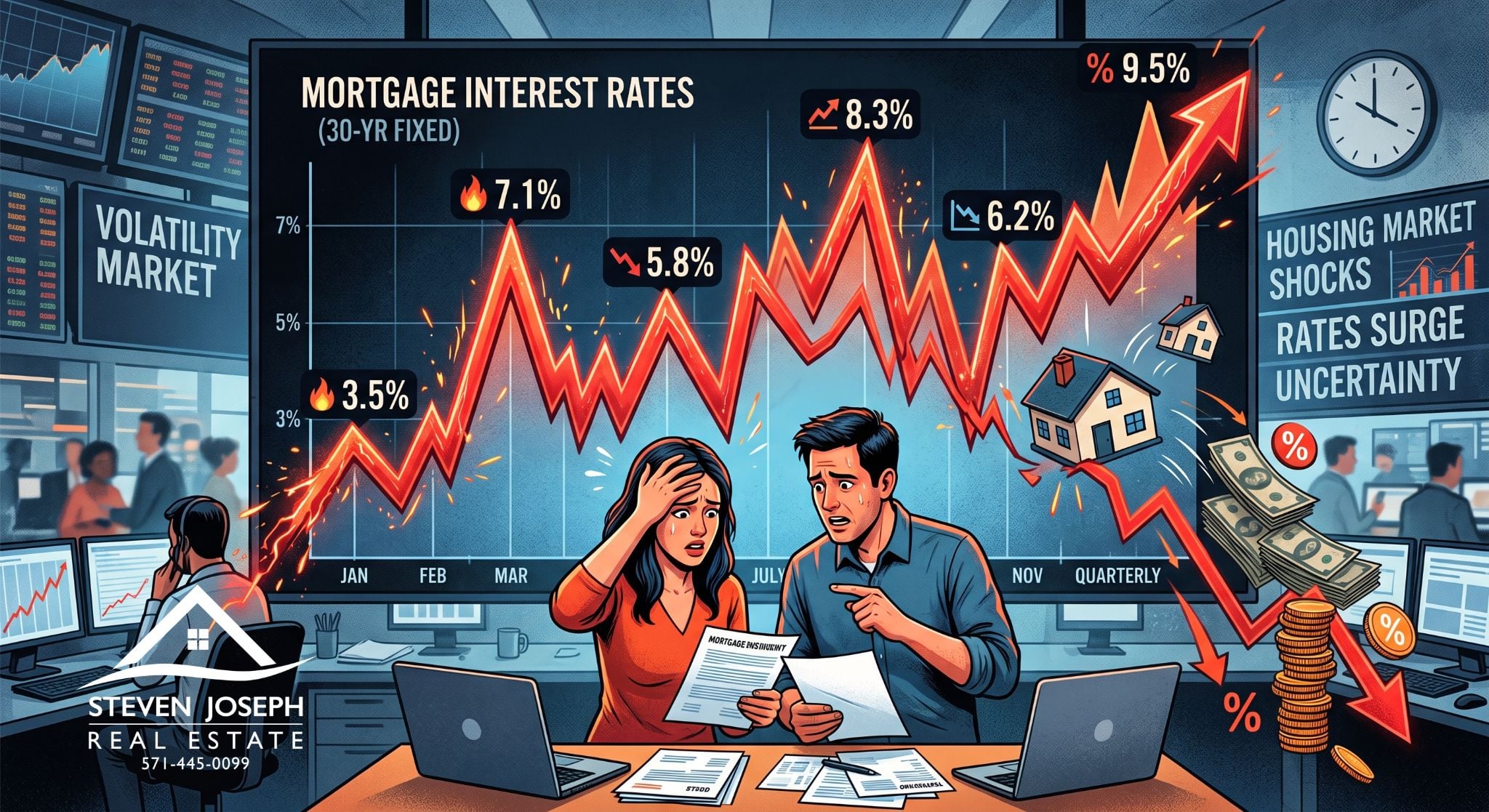
Mortgage rates can shift fast enough to change a home search or listing plan within days. That kind of movement catches a lot of buyers and sellers off guard, especially when they assumed rates would stay roughly where they were when they first started planning. Mortgage rate volatility simply means rates are moving up and down more quickly and more frequently than most people expect, and the effects are not just numbers on a screen.
A small rate change can adjust monthly payments by tens of dollars, push buyers past their qualification limits, and reshape how many people can realistically afford a given home. For sellers, the same shift can change who shows up to a showing and how motivated those buyers are. Understanding what is driving these swings, and what they mean for real decisions, is more useful than tracking headlines without context.
This guide walks through the mechanics of rate volatility in plain terms, covering how it affects affordability, buyer demand, seller strategy, and the broader market conditions shaping transactions right now.
Why a Small Rate Jump Can Change Everything
A move from around 6.71 percent to 7.03 percent on a $400,000 loan adds roughly $90 per month to a mortgage payment. That might not sound like much on its own, but most buyers are not looking at a mortgage payment in isolation. Once property taxes, homeowner's insurance, HOA dues, and utilities are factored in, that extra $90 can be the difference between a budget that works and one that does not.
Rate volatility changes affordability faster than home prices typically do. A seller can cut their list price by $10,000, and it might reduce the monthly payment by around $55. But a half-point rate increase can wipe out that savings and then some. That is why buyers can feel the market shift even when prices appear stable on paper.
For sellers, the math creates a real challenge. The same home that attracted multiple offers when rates were lower can suddenly feel out of reach for a portion of the buyer pool when rates climb. Buyers who were pre-approved at a lower rate may find they no longer qualify for the same purchase price, or they may simply feel less confident about stretching their budget in an uncertain rate environment.
What makes this particularly important is the speed at which it happens. Home prices adjust slowly, often over months. Rate changes can happen in days, sometimes hours. A buyer who got pre-approved two weeks ago and has not rechecked their numbers might be working from outdated information by the time they make an offer. Sellers who priced their home based on buyer activity from a month ago may be wondering why traffic has slowed without realizing the rate environment has already shifted under them.
Staying current on rate movement is not about obsessing over every tick. It is about making sure the numbers you are working from actually reflect the market you are buying or selling in right now.
What Buyers Feel First When Rates Swing
Higher rates reduce borrowing power even when nothing else about a buyer's financial situation has changed. The same income, the same credit score, the same savings, and yet the amount of home that income can support goes down as rates go up. A buyer who qualified for a $450,000 loan at 6.5 percent may only qualify for around $420,000 at 7.25 percent, depending on their specific debt load and lender guidelines.
That gap matters in a market where inventory is limited in certain price ranges. Buyers who get pushed down in purchase price may find themselves competing in a more crowded bracket, or they may have to increase their down payment to keep the monthly payment in a workable range. Neither option is easy, but both are worth running through with a lender before assuming the original plan still holds.
Debt-to-income ratio, or DTI, is one of the most important numbers in this conversation. Lenders use it to measure how much of a buyer's gross monthly income goes toward debt payments, including the new mortgage. Most conventional loans require a DTI at or below 43 to 45 percent. When rates rise, the monthly mortgage payment increases, which pushes the DTI higher even if the buyer has not taken on any new debt. Some buyers who were comfortably within qualification limits at 6.75 percent may find themselves over the threshold at 7.25 percent.
Rate locks become especially important when rates are moving quickly. A rate lock is an agreement with a lender to hold a specific interest rate for a set period, typically 30 to 60 days, while the buyer completes the purchase process. In a stable rate environment, locks are somewhat routine. In a volatile one, they are a genuine financial tool. Buyers who are close to their affordability ceiling should ask their lender about lock options early, not after an offer is already accepted.
Getting pre-approved and then watching rates move without rechecking the numbers is one of the more common ways buyers end up surprised at closing. A pre-approval from several weeks ago reflects the rate environment at that time, not today's. Checking in with a lender when rates move noticeably, even by a quarter point, is a simple step that keeps the budget realistic.
The goal is not to time the market perfectly. Rates are influenced by factors that even professional traders cannot consistently predict. What buyers can control is how clearly they understand their own numbers before making an offer, and whether those numbers are current enough to actually be useful.
What Sellers Notice When Buyers Get More Cautious
Rising rates do not always push prices down immediately, but they do tend to slow things down. Fewer buyers can qualify, and those who can may move more carefully, take longer to make decisions, and negotiate harder than they would have in a lower-rate environment.
The effects show up in specific, measurable ways. Showings slow down, days on market stretch out, and the offers that do come in often include more contingencies or lower starting prices. Sellers who were expecting a quick sale based on what the market looked like six months ago may be surprised to find the process taking longer and requiring more flexibility.
Current market data reflects this shift. Inventory has been rising, and more active listings are seeing price reductions as sellers adjust to a more payment-sensitive buyer pool. The national median existing-home price is still modestly higher year over year, which means buyers are feeling squeezed from both sides, higher rates and prices that have not meaningfully dropped. That combination makes buyers more selective and more cautious about overextending.
Sellers who understand this dynamic have more options than those who wait and react. Pricing correctly from the start matters more in a rate-sensitive market than it does when demand is running hot. Chasing the market down with repeated price cuts tends to signal to buyers that something is wrong with the property, which creates its own set of problems. A well-priced listing from day one attracts more serious buyers and tends to close faster.
Beyond list price, sellers can also consider concessions that directly address the affordability problem buyers are facing. Closing cost credits, for example, give buyers more cash to work with at the table. A seller-paid rate buydown, where the seller contributes funds to temporarily or permanently reduce the buyer's interest rate, can make a meaningful difference in monthly payment and help close a deal that might otherwise fall apart. These tools are worth discussing with an agent who understands how to structure them effectively.
Monitoring showing activity closely after a listing goes live is also worth doing. A sudden drop in traffic after the first week is often a signal that the price needs to be reconsidered before the listing goes stale, not after it has sat for 45 days.
The Numbers Behind Today's Market Pressure
The average 30-year fixed mortgage rate reached just over 7 percent in late September 2026 after sitting in the high 6 percent range earlier in the month. That kind of movement within a single month is a good example of how quickly the rate environment can shift, and why buyers and sellers who are not paying attention can find themselves working from outdated assumptions.
Existing-home sales have softened alongside the rate increases, while inventory has continued to climb. The market is not in freefall, but it is clearly feeling the weight of affordability pressure. More listings are sitting longer, more sellers are cutting prices, and buyers are taking more time before committing. That combination describes a market that has shifted in favor of buyers in many areas, though the degree varies significantly depending on location.
The fact that the national median existing-home price is still slightly higher year over year adds another layer of difficulty for buyers. Rates are up, prices have not dropped enough to compensate, and that math leaves a lot of buyers feeling like they are running in place. For sellers, it means the pool of buyers who can comfortably afford their home at current rates is smaller than it was 12 to 18 months ago, even if the asking price has not changed.
Price reductions have become more common across active listings, which tells you that sellers are adjusting to this reality, even if gradually. The buyers who are still active in this market tend to be more financially prepared and more deliberate. They are not going to stretch past their comfort zone the way buyers sometimes did when rates were at historic lows and competition was intense.
What this data points to is a market in transition. It is not a crash, and it is not a boom. It is a recalibration, and the buyers and sellers who do best in that kind of environment are the ones who are working with current information rather than assumptions from a different rate climate.
Why Mortgage Rates Move So Fast
The Federal Reserve gets a lot of attention when mortgage rates change, but the Fed does not set mortgage rates directly. What the bond market does is far more relevant to the rate a buyer will actually see on a loan estimate. Specifically, the 10-year Treasury yield is one of the most useful signals to watch, because mortgage rates tend to move in the same general direction.
When investors are worried about inflation or economic instability, they often sell bonds, which pushes yields higher. Mortgage lenders, who fund loans by selling mortgage-backed securities to investors, have to offer rates that compete with those rising yields. The result is that mortgage rates climb even without any direct action from the Fed.
Inflation reports are one of the fastest-moving triggers. When a Consumer Price Index report comes in higher than expected, it signals to the market that inflation is not cooling as quickly as hoped. That tends to push yields up, and mortgage rates can respond within hours. A single data release on a Friday morning can shift rates before the weekend, which is why buyers who are under contract and waiting to lock should stay in close contact with their lender during major economic reporting periods.
Economic uncertainty works similarly. When markets are unsettled, whether due to geopolitical events, labor market data, or shifting expectations around Fed policy, investors move money around in ways that affect bond yields and, by extension, mortgage pricing. The speed of that reaction is what catches most people off guard.
Knowing this does not mean buyers need to become bond traders. It means understanding that the rate environment can change based on news events that have nothing to do with the housing market itself, and that checking in with a lender after a major economic headline is a reasonable and practical habit to build.
How Buyers and Sellers Can Respond Without Panicking
Rate volatility does not require anyone to rush into a decision or freeze up entirely. It does require sharper information and a clearer sense of what the numbers actually mean for your specific situation. For buyers and sellers, that looks different, but the underlying principle is the same.
For buyers, a few practical steps make a real difference when rates are moving around. Rechecking pre-approval numbers when rates shift noticeably keeps the budget accurate and avoids surprises. Shopping based on monthly payment rather than purchase price alone gives a more honest picture of what is actually affordable. Asking a lender about rate lock options early in the process, especially when rates have been climbing, is worth doing before an offer is accepted rather than after.
For sellers, the focus shifts to understanding how the current rate environment is affecting the specific buyers who are looking at homes in their price range. Pricing with current affordability in mind rather than peak-market comparables gives a listing a better chance of generating real offers. Watching showing activity in the first two weeks tells you a lot about whether the price is landing correctly. Being open to concessions like closing cost credits or rate buydowns can keep a deal alive when a buyer is close but not quite there.
Both sides benefit from paying attention to what is happening locally, not just nationally. Days on market, inventory levels, and price flexibility vary widely from one neighborhood to the next, and national headlines do not always reflect what is happening on a specific street. Working with an agent who tracks local data closely is one of the most straightforward ways to stay grounded in what the market is actually doing.
Volatility is uncomfortable, but it is also a normal part of how real estate markets function. Having current numbers, a realistic strategy, and the right people around you makes it much more manageable than it looks from the outside.
Conclusion
Mortgage rate volatility affects more than the headlines. It changes payment math, qualification thresholds, buyer demand, and seller leverage in real time, often faster than most people expect.
Buyers who keep a close eye on affordability, debt-to-income limits, and rate lock timing are in a much stronger position when rates are moving. A pre-approval that was accurate three weeks ago may not reflect what a lender will approve today, and knowing that before making an offer is a significant advantage.
Sellers who understand how rate swings reshape their buyer pool are better equipped to price correctly, respond to slower activity, and use concessions strategically rather than reactively. The market is not moving against sellers, but it is moving differently than it did when rates were lower, and that distinction matters when setting expectations and making decisions.
Rates are going to keep moving. What changes when you understand how and why they move is that the market starts to feel less unpredictable and more like something you can actually plan around.
Check out this article next